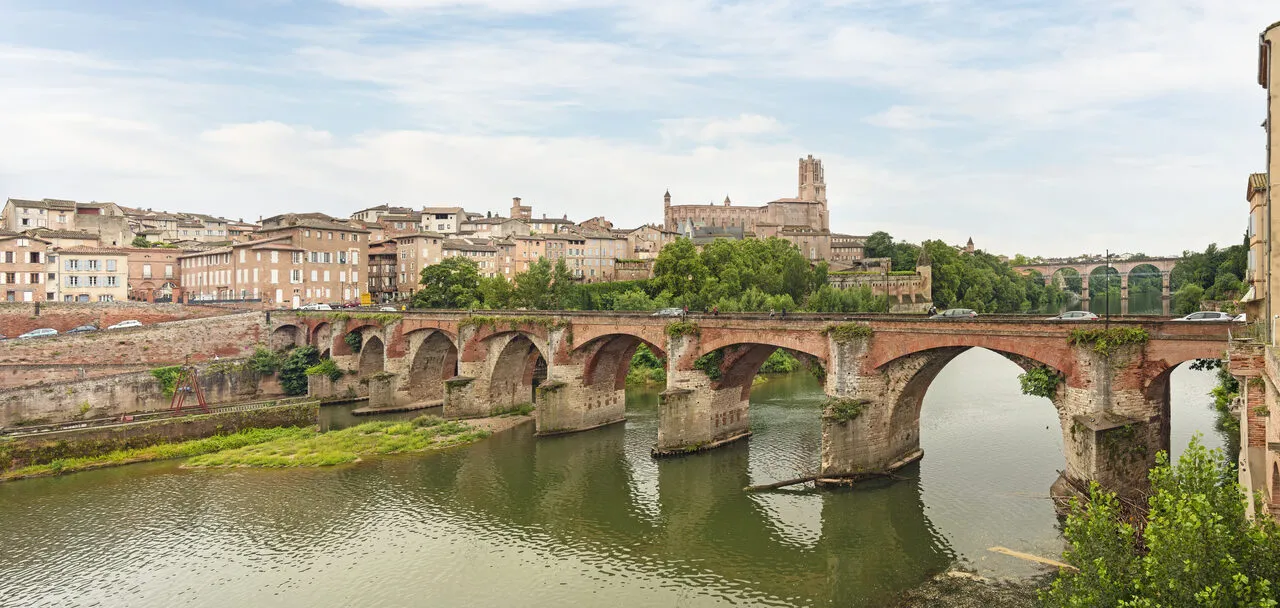
Episcopal City of Albi
Cultural
1337
2010
Cultural
Description
On the banks of the Tarn river in south-west France, the old city of Albi reflects the culmination of a medieval architectural and urban ensemble. Today the Old Bridge (Pont-Vieux), the Saint-Salvi quarter and its church are testimony to its initial development (10th -11th centuries). Following the Albigensian Crusade against the Cathar heretics (13th century) it became a powerful episcopal city. Built in a unique southern French Gothic style from local brick in characteristic red and orange colours, the lofty fortified Cathedral (late 13th century) dominates the city, demonstrating the power regained by the Roman Catholic clergy. Alongside the Cathedral is the vast bishop’s Palais de la Berbie, overlooking the river and surrounded by residential quarters that date back to the Middle Ages. The Episcopal City of Albi forms a coherent and homogeneous ensemble of monuments and quarters that has remained largely unchanged over the centuries.
Inscription details
| Field | Value |
|---|---|
| WHS ID | 1337 |
| Inscribed | 2010 |
| Category | Cultural |
| Criteria | (iv)(v) |
| State party | France |
| Transboundary | No |
| French name | Cité épiscopale d'Albi |
Protected monuments
| Monument | Commune | Protected |
|---|---|---|
| Fort Saint-Georges de Chinon | Chinon | 1926 |
| Maison de maître de la Charpenterie | Cornillé-les-Caves | 2007 |
| Château de la Bretesche | Missillac | 1926 |
| Manoir de Sarceau de Sarcé | Sarcé | 1989 |
| Maison de Coulombs | Coulombs | 1972 |
| Eglise paroissiale Saint-Vincent | Villedômer | 1948 |
| Ancienne halle de Sainte-Sévère-sur-Indre | Sainte-Sévère-sur-Indre | 1936 |
| Manoir du Plessis de Savonnières | Savonnières | 1948 |
| Dolmen à transept du Riholo | Herbignac | 1980 |
| Chapelle de Soussigné | Martigné-Briand | 1965 |
| Ancienne église de Monthault | Romorantin-Lanthenay | 1936 |
| Maison dite de Florent Tissart | Lavardin | 1930 |
| Maison d'Adam et Eve ou de l'Arbre de Vie | Angers | 1922 |
| Ruines du château de Sagonne | Sagonne | 1914 |
| Eglise paroissiale Saint-Vincent | Antogny le Tillac | 1926 |
Loire appellations
| Appellation | Avg score | Reviews | Color |
|---|---|---|---|
| Sancerre | 89.3 | 554 | White |
| Muscadet Sèvre et Maine | 88.6 | 237 | White |
| Pouilly-Fumé | 89.6 | 153 | White |
| Vouvray | 88.4 | 153 | White |
| Touraine | 86.3 | 85 | White |
| Chinon | 88.7 | 72 | Red |
| Menetou-Salon | 87.3 | 69 | White |
| Crémant de Loire | 87.5 | 54 | Sparkling |
| Val de Loire | 85.6 | 41 | White |
| Saumur | 88.4 | 40 | White |
| Anjou | 87.6 | 36 | White |
| Rosé d'Anjou | 84 | 35 | Rosé |
Source: UNESCO World Heritage Centre. Updated: April 14, 2026.